

Dataset
Customer survey
Observed satisfaction, product use, and customer characteristics.
Infrastructure
Governed knowledge. Ready for people and AI.
Bring datasets, population benchmarks, and models into Wick’s AI-native infrastructure. Their meaning, documentation, and accumulated intelligence stay connected as your team and AI build on them.
Get a demoHow Wick prepares datasets
For each dataset, Wick captures the source context and processes every column. Taxonomy, inherited knowledge, and computation prepare those observations for further analysis.
 01
Bring the source, methodology, population, and companion documents together.
 02
Identify each variable by what it means and how its values are structured.
 03
Apply the documentation and guidance accumulated for its species.
 04
Build statistical profiles and examine relationships with other variables.
 05
Check the results, surface quality flags, and retain the caveats.
Taxonomy & accumulated knowledge
A column name tells only part of the story. Wick identifies both the meaning of a variable and its structure: the response scale, value definitions, and missing-data patterns.
Each column is a specimen. When it matches a known species, it inherits the knowledge Wick has already accumulated about that kind of variable.
Meaning and structure establish which variables belong together.
Definitions, observations, and recommended protocols travel with the classification.
“I trust this brand.”

Different names can describe the same measure. The underlying meaning establishes its semantic identity.

Shared meaning alone is not enough. Structure must match before specimens share a species.
A matching specimen inherits a monograph. A consequential new classification receives expert review.
From specimen to evidence
Classification gives Wick a way to understand the variable. Processing adds the evidence people and agents can use to reason about it.
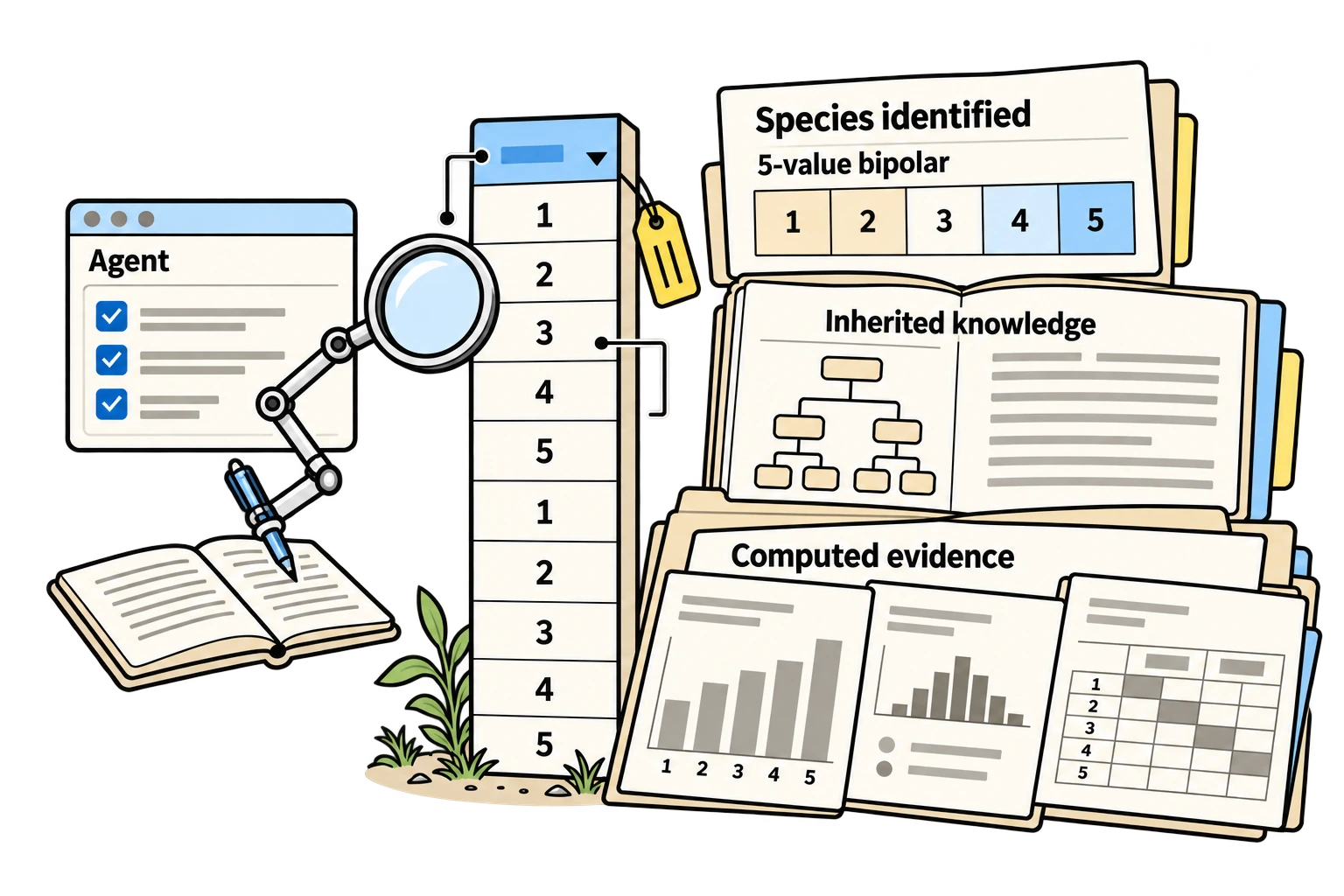
Distributions, base sizes, missingness, and quality flags describe the values actually observed.

Crossings with other specimens reveal how responses vary across the audience.

Structured evidence retains its definitions, source context, and limitations.
Working together
A dataset records what was observed. A population benchmark helps calibrate who it represents. A model can add evidence about what is likely or what matters.
Dataset
Observed satisfaction, product use, and customer characteristics.

Population benchmark
The reference mix used to calibrate the survey to the customer base.

Model
A trained model applied to compatible inputs to estimate likelihood to renew.
Compare the needs and experiences of customers with different renewal scores, using calibrated survey evidence and retaining the sources, methods, and model caveats.
At home in Foundry
Foundry is where your team finds and manages datasets, population benchmarks, models, and the intelligence built around them. Infrastructure supports their preparation and use across Wick.
Inspect definitions, methodology, population context, or model purpose before putting an asset to work.

Keep source relationships, validation notes, and caveats available alongside the outputs built from them.

Bring prepared assets and saved intelligence into the next analysis or connected AI workflow.
Sources, definitions, methods, and caveats stay connected to the derived data and evidence created from them—in Wick and through connected AI systems.
Bring your audience assets together with the documentation that makes them understandable.

Spreadsheets, survey exports, and codebooks.

Source files and recurring deliveries.

Structured tables and modeled outputs.

Customer records and audience activity.

Wick’s specialists validate consequential additions to the knowledge layer. Our engineers help connect the foundation to your data, AI systems, and real work.
Read about security