
Key Findings
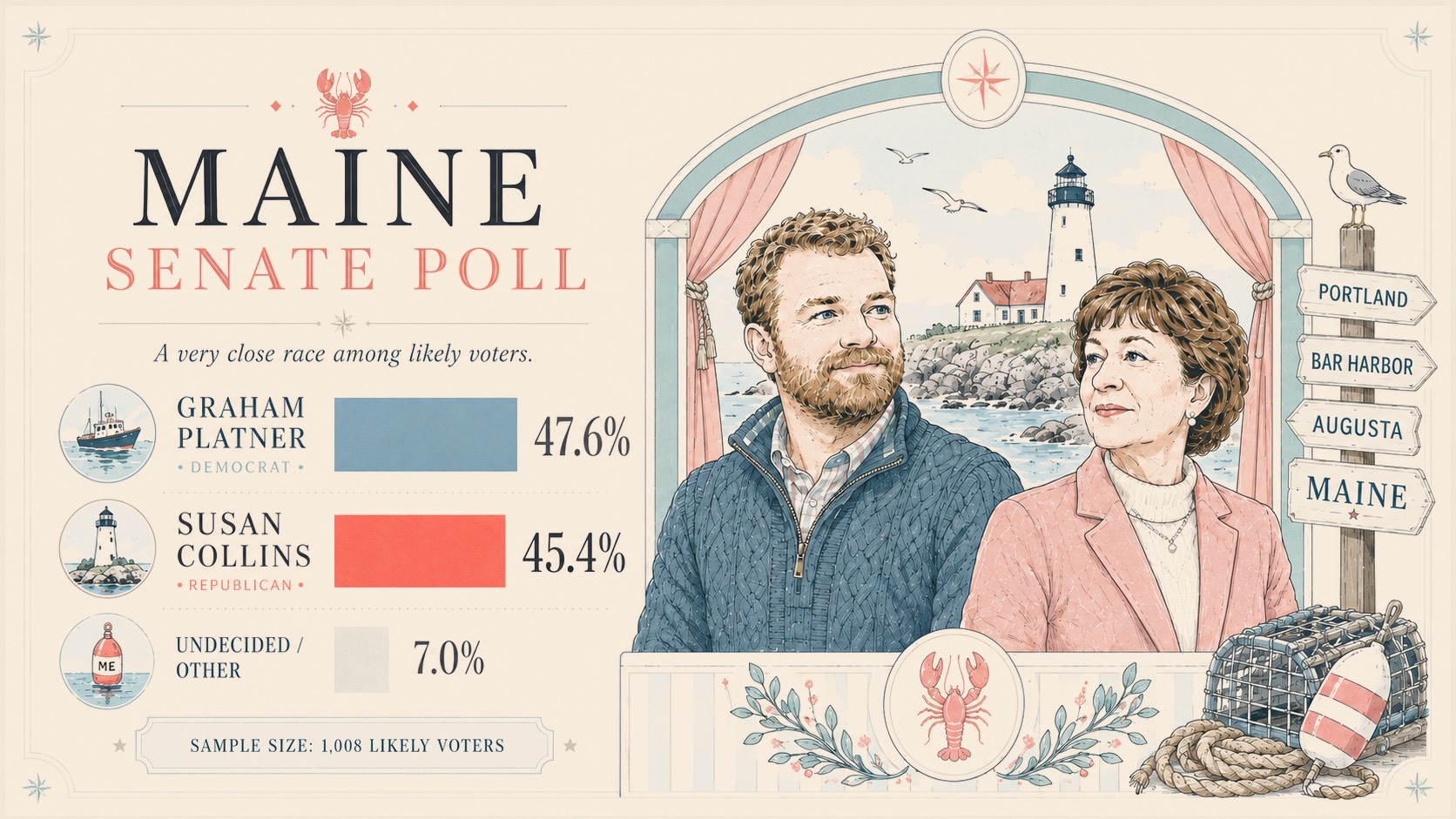
Graham Platner receives 47.6% in the U.S. Senate race, Susan Collins receives 45.4%, and 7.0% are undecided or support another candidate. The 2.2-point difference is within the survey’s ±3.1-point margin of error.
Most likely voters have already formed an opinion of both candidates, and neither is viewed favorably by a majority. Collins is rated favorably by 45.4% and unfavorably by 54.4%; Platner is rated favorably by 46.3% and unfavorably by 53.4%. The survey therefore finds a close contest between two well-known candidates with limited room for movement.
The broader environment presents challenges for Collins. Donald Trump’s job approval stands at 41.9%, while 58.0% disapprove. Cost of living and inflation is the leading Senate voting issue, named by 35.6%. At the same time, the candidate-specific results are mixed: Collins retains a substantial advantage on moral character, while Platner leads on change, working-class connection, and several other traits.
The U.S. Senate Race
Collins leads among men by 3.0 points and among rural and small-town voters by 7.8 points. Platner leads among women by 6.9 points, urban voters by 32.0 points, and suburban voters by 24.1 points. Platner also leads among independents, 51.5% to 37.8%, and among moderates, 47.8% to 40.6%.
Both candidates have consolidated most of their partisan support. Collins receives 94.5% among Republicans and 93.0% among voters who report supporting Trump in 2024. Platner receives 86.8% among Democrats and 86.6% among reported Harris voters.
Neither candidate is viewed favorably by a majority
Collins’s 45.4% favorable rating includes 24.5% who view her very favorably; 42.0% view her very unfavorably. Platner’s 46.3% favorable rating includes 29.1% who view him very favorably; 47.4% view him very unfavorably. Nearly all respondents report an opinion of each candidate.
Collins has lost support among voters who previously crossed party lines
The survey’s recalled 2020 Senate vote is Collins 56.0% and Sara Gideon 34.4%, a larger margin than the certified result. Recall of past votes often overstates support for the winner, so these figures should be treated as directional. Even with that limitation, the movement among reported Harris voters is notable: 24.0% say they supported Collins in 2020, while 5.2% support her now. By comparison, Collins retains 93.0% of reported Trump voters.

Candidate traits show different strengths
Collins leads Platner by 24.8 points on being morally upstanding, 49.1% to 24.3%, including a 17.2-point advantage among independents. Platner leads on being the candidate of change and new ideas, 53.0% to 26.2%; being more in touch with working-class Mainers, 50.0% to 40.5%; and keeping the United States out of unnecessary wars, 46.7% to 34.3%. Voters are also more likely to associate Collins with serving wealthy and powerful interests, 52.2% to 20.4%.
The competing statements produce a similar division. By 52.7% to 43.1%, voters choose the statement that Collins votes with Trump 95% of the time over the statement describing her as one of the Senate’s most independent and bipartisan members. By 50.9% to 45.1%, they choose the argument for new leadership over the argument that her seniority gives Maine influence in Washington.
Views of the Platner Controversies
When the controversies are considered together, 52.5% say their opinion of Platner has become more negative, including 41.3% who say it has become much more negative. Another 15.2% say their opinion has become more positive, 31.3% say it is about the same, and 0.9% are unsure.
A 55.8% majority says the controversies will be important to most Maine voters in November. Awareness is high: the share saying they had not heard of each allegation ranges from 0.8% to 1.1%.
Voters are divided over how to interpret the controversies
Statewide, 48.5% choose the statement that the controversies reveal serious character flaws, while 47.4% choose the statement that Washington insiders and the media are trying to take down a candidate who threatens the political establishment. Independents choose the Washington-takedown statement by 52.6% to 40.2%; moderates choose it by 48.7% to 42.5%.
Concern also extends into Platner’s coalition. Among Democrats, 40.2% say they are very or somewhat concerned about the physical-abuse allegations. Among reported Harris voters, 22.9% say the controversies made their opinion of Platner more negative. The findings show that concern about the allegations and skepticism about the source or purpose of the criticism can coexist.
Political Environment and Issues
Trump is rated negatively by a majority of likely voters, and cost of living is the leading issue in the Senate vote. Character and personal conduct also register as a top issue for about one voter in ten.
Trump’s ratings are substantially negative
Trump’s job approval is 41.9%, while 58.0% disapprove. Most of the disapproval is strong: 54.7% strongly disapprove and 3.3% somewhat disapprove. Among independents, 32.9% approve and 66.9% disapprove. His personal favorability is similar, at 41.7% favorable and 58.3% unfavorable.
Cost of living leads the issue agenda
Cost of living and inflation is the most frequently selected issue overall and within each party group: 41.5% of Democrats, 30.9% of Republicans, and 34.6% of independents name it as their leading consideration. Immigration and border security ranks second overall at 12.7%, followed by Social Security and Medicare at 11.7%.
Character and personal conduct is selected by 10.7% overall. It is more prominent among reported Trump voters, at 17.7%, than among reported Harris voters, at 4.1%. This difference is consistent with Collins’s advantage on the morally upstanding trait and the concern Republicans express about the Platner allegations.
Voter Firmness
Overall, 88.7% say their vote choice is firm, 6.7% say they could still be persuaded, and 4.5% remain genuinely undecided. The share that is persuadable or undecided is larger among somewhat liberal voters (19.5%), moderates (19.3%), independents (17.7%), and suburban voters (16.5%).
Reported Harris voters are more than twice as likely as reported Trump voters to remain in play, 14.3% to 6.6%. Republicans are the firmest party group: 97.1% say their choice is very unlikely to change.
Measures to follow in the next wave
Four measures will help show whether the race is moving: the total persuadable and undecided share, now 11.2%; Collins’s support among reported Harris voters, now 5.2%; the competing statements on Collins’s independence, which currently favor the Trump-alignment criticism by 52.7% to 43.1%; and the interpretation of the Platner controversies, where the character-flaw statement leads the Washington-takedown statement by 48.5% to 47.4% statewide, but trails it among independents. Movement on these measures would show whether either candidate is changing views beyond the partisan bases.
The Pollster’s Read
The data ends here. What follows is a read, not a result: judgment drawn from decades of measuring public opinion and watching elections confirm the numbers, defy them, and everything in between. We think it is worth having. We would never call it math.
Our read is that Collins is more likely to gain than to lose ground from this starting point. That view begins with her history. Public polling in 2020 regularly showed Collins trailing Sara Gideon, yet Collins won by roughly nine points on the first count. The current survey contains a reminder of that durable support: respondents recall the 2020 race as Collins 56% and Gideon 34%, a margin wider than the certified result. Winner’s recall bias clearly contributes to that difference, but it also identifies an electorate in which many voters remember themselves as Collins supporters. At 45.4% today, she is not retaining all of them.
Her opportunity is concentrated among voters she has won before. Collins already holds 94.5% of Republicans, so additional gains would have to come from independents, moderates, suburban voters, and voters who supported Harris in 2024. Those groups account for much of the remaining persuadable vote. They are also not uniformly comfortable with Platner: 22.9% of reported Harris voters say the controversies made them more negative, and Collins leads by 24.8 points on the morally upstanding trait. Increased campaign attention to Platner’s conduct could therefore return some former Collins voters to her column. The survey does not yet show that conversion; it shows the constituency from which it could come.
The countervailing evidence is substantial. Trump’s job rating is 16.1 points underwater, the criticism that Collins votes with him 95% of the time defeats her independence argument by 9.6 points, and the new-leadership statement defeats the seniority argument by 5.8 points. If the campaign is primarily a judgment on Trump or Collins’s tenure, Platner is well positioned to retain his lead. If attention shifts toward Platner’s character and Collins reclaims some of her former crossover support, the race is likely to narrow. Our expectation is a close contest in which Collins has room to improve, but her path depends on rebuilding an independence brand that this survey shows has weakened.
Methodology
The Maine 2026 Senate General Election Survey was conducted by Wick on behalf of 2Way from June 11–14, 2026, among 1,008 likely voters in Maine. Respondents were recruited by text and completed the survey online. Results were weighted, and the margin of error for the full sample is ±3.1 percentage points at the 95% confidence level.
Subgroup estimates have wider margins of error than the statewide results and should be treated as directional. Percentages may not add to 100% because of rounding. All figures on this page were recomputed from the weighted crosstab file.